A child’s learning does not begin only when a lesson starts. It can begin while they are walking through a corridor, looking up at something unfamiliar, or asking a question because something in the space around them has caught their attention.
At Pearl of Africa International School, we believe the spaces children move through each day should support that kind of curiosity. A school is a place where children spend a large part of their day noticing, thinking, forming ideas, building confidence, and making sense of the world around them. That is why the learning environment matters.
Children are naturally observant. They notice colours, shapes, displays, sounds, conversations, and small details that adults may walk past without a second thought. When a school environment is thoughtfully created, these details can become part of the learning journey. They can invite children to pause, ask, compare, imagine, and connect what they see with what they are learning in class.
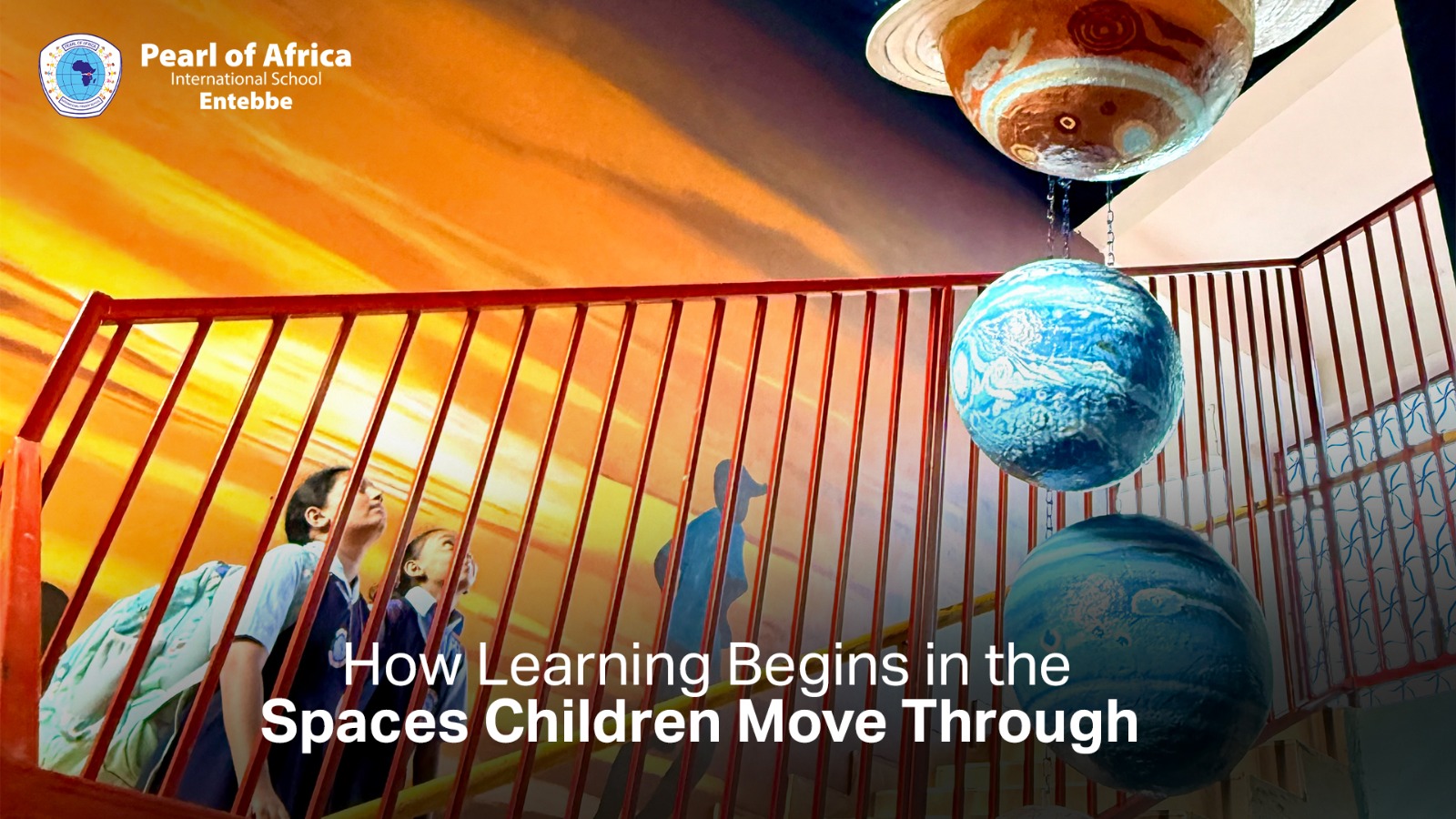
One of the ways this comes to life at Pearl of Africa International School is through learning spaces that invite curiosity beyond the classroom. From visual displays to features such as our space-themed ceiling mural with a suspended solar system installation, the environment is designed to help children observe, wonder, ask questions, and make connections with what they learn.
A child walking through this space may begin by noticing the planets above them, but that moment can quickly become more meaningful. They may identify Saturn by its rings, wonder about Mercury, ask why some planets appear larger than others, or become curious enough to learn more on their own. In that simple act of looking up, a question is formed, and sometimes that question becomes the beginning of a deeper conversation.
This is where the school environment becomes powerful. It supports learning in ways that feel natural to children. Science becomes easier to imagine when learners can see reminders of it around them. A topic becomes more familiar when it appears in the spaces they pass through every day. Curiosity grows when children are surrounded by things that encourage them to look again and think a little further.
A thoughtful learning environment does not need to be overwhelming to be meaningful. It can be found in a display that celebrates learners’ work, a reading area that invites quiet discovery, a classroom wall that supports a topic, or a shared space that encourages children to ask questions. What matters is the intention behind the space and how it supports the way children experience school.
For parents, choosing a school often involves looking at the curriculum, teachers, facilities, and academic pathways. These are important parts of the decision. Alongside them, the daily environment also plays a meaningful role in how a child feels about learning. Children should feel surrounded by spaces that make them comfortable enough to ask, confident enough to share, and curious enough to explore.
At Pearl of Africa International School, we see the environment as part of the whole learning experience. Our learners are surrounded by spaces that support inquiry, imagination, and confidence. These spaces help children understand that learning is not limited to one room, one lesson, or one subject. It can be found in what they see, what they ask, what they create, and how they engage with the world around them.
This matters because children remember the places that made them feel curious. They remember the moments when a question was welcomed. They remember the details that made a topic feel real. A child who pauses to look at a planet today may later ask about space, distance, gravity, or the universe. One question can lead to another, and that is how curiosity begins to grow into deeper learning.
That is the kind of experience we continue to nurture at Pearl of Africa International School. We want children to move through school feeling that there is always something worth noticing, something worth asking about, and something new to understand.
Because in the right environment, even an ordinary walk through school can become the beginning of a question.Your Child Is Already Learning Before the Lesson Begins
A child’s learning does not begin only when a lesson starts. It can begin while they are walking through a corridor, looking up at something unfamiliar, or asking a question because something in the space around them has caught their attention.
At Pearl of Africa International School, we believe the spaces children move through each day should support that kind of curiosity. A school is a place where children spend a large part of their day noticing, thinking, forming ideas, building confidence, and making sense of the world around them. That is why the learning environment matters.
Children are naturally observant. They notice colours, shapes, displays, sounds, conversations, and small details that adults may walk past without a second thought. When a school environment is thoughtfully created, these details can become part of the learning journey. They can invite children to pause, ask, compare, imagine, and connect what they see with what they are learning in class.
One of the ways this comes to life at Pearl of Africa International School is through learning spaces that invite curiosity beyond the classroom. From visual displays to features such as our space-themed ceiling mural with a suspended solar system installation, the environment is designed to help children observe, wonder, ask questions, and make connections with what they learn.
A child walking through this space may begin by noticing the planets above them, but that moment can quickly become more meaningful. They may identify Saturn by its rings, wonder about Mercury, ask why some planets appear larger than others, or become curious enough to learn more on their own. In that simple act of looking up, a question is formed, and sometimes that question becomes the beginning of a deeper conversation.
This is where the school environment becomes powerful. It supports learning in ways that feel natural to children. Science becomes easier to imagine when learners can see reminders of it around them. A topic becomes more familiar when it appears in the spaces they pass through every day. Curiosity grows when children are surrounded by things that encourage them to look again and think a little further.
A thoughtful learning environment does not need to be overwhelming to be meaningful. It can be found in a display that celebrates learners’ work, a reading area that invites quiet discovery, a classroom wall that supports a topic, or a shared space that encourages children to ask questions. What matters is the intention behind the space and how it supports the way children experience school.
For parents, choosing a school often involves looking at the curriculum, teachers, facilities, and academic pathways. These are important parts of the decision. Alongside them, the daily environment also plays a meaningful role in how a child feels about learning. Children should feel surrounded by spaces that make them comfortable enough to ask, confident enough to share, and curious enough to explore.
At Pearl of Africa International School, we see the environment as part of the whole learning experience. Our learners are surrounded by spaces that support inquiry, imagination, and confidence. These spaces help children understand that learning is not limited to one room, one lesson, or one subject. It can be found in what they see, what they ask, what they create, and how they engage with the world around them.
This matters because children remember the places that made them feel curious. They remember the moments when a question was welcomed. They remember the details that made a topic feel real. A child who pauses to look at a planet today may later ask about space, distance, gravity, or the universe. One question can lead to another, and that is how curiosity begins to grow into deeper learning.
That is the kind of experience we continue to nurture at Pearl of Africa International School. We want children to move through school feeling that there is always something worth noticing, something worth asking about, and something new to understand.
Because in the right environment, even an ordinary walk through school can become the beginning of a question.